Teeth Whitening in Amsterdam: What Actually Works, What Does Not, and What It Costs at a Dental Clinic
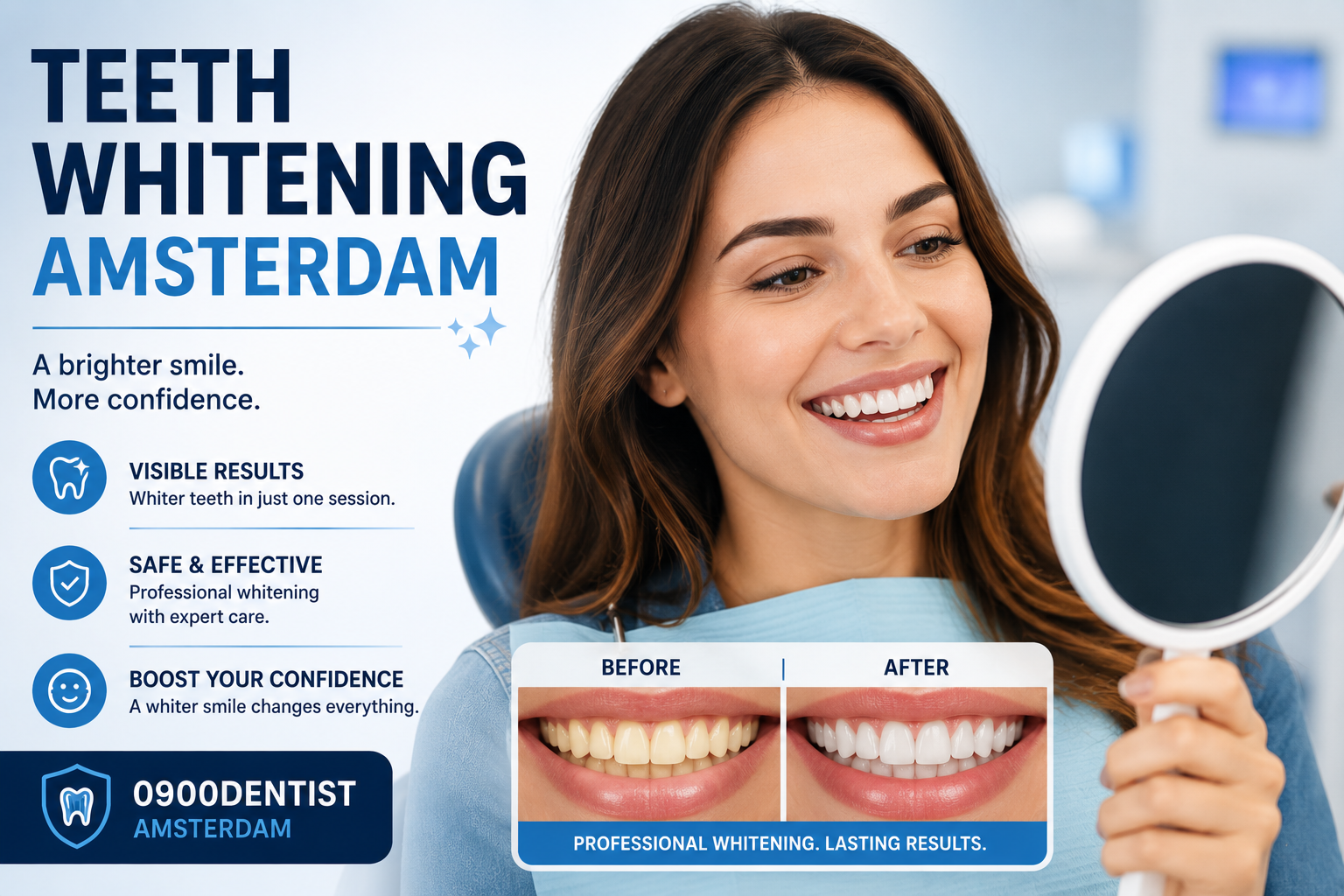
Teeth Whitening in Amsterdam: What Actually Works, What Does Not, and What It Costs at a Dental Clinic
Medically reviewed by the clinical team at 0900 Dentist, Lijnbaansgracht 162, Amsterdam — led by Mehdi Hashemi, co-founder and director.
The teeth whitening market in Amsterdam is split between three very different categories: pharmacy strips, cosmetic beauty salons, and dental clinic treatment. The price difference runs from €30 to €800. The results difference is just as wide — and not always in the direction people expect.
This post explains what drives whitening results, what the clinical options actually are, and why the cheapest option frequently produces the least useful outcome.
 blog6inbetween
Why Teeth Whiten — and Why They Stop
Tooth colour is determined by two factors: the outer enamel layer (translucent, reflects light) and the inner dentine (naturally yellow-toned, visible through enamel). Most surface discoloration — from coffee, tea, red wine, tobacco — sits in the enamel surface and responds well to whitening. Intrinsic discoloration — from ageing, tetracycline antibiotics, or fluorosis — sits in the dentine and is far harder to shift.
Whitening agents (hydrogen peroxide or carbamide peroxide) work by releasing oxygen molecules that penetrate enamel and break down stain compounds in the dentine. Higher concentrations act faster but require professional soft tissue isolation. Lower concentrations are safer for unsupervised use but more limited in effect. This is the relevant distinction between professional and over-the-counter products — not brand names.
The Three Whitening Options, Honestly Compared
Over-the-Counter Strips and Gels (€20–€80)
Products like Crest 3D White strips use low-concentration peroxide — maximum 0.1% hydrogen peroxide under EU cosmetics regulation, far below clinical concentrations. For mild surface staining, they produce real but modest results over two to four weeks. For moderate or intrinsic staining, results are minimal regardless of duration. They are limited by regulation, not by poor formulation.
Beauty Salon Whitening (€80–€250)
Under EU law, whitening products above 0.1% hydrogen peroxide can only be supplied and applied by dental professionals. Any salon offering “professional” whitening without a dentist is either using the same low-concentration product as pharmacy strips at a higher price, or operating illegally. Improperly applied high-concentration peroxide on unprotected gum tissue causes burns that can result in lasting recession. If a salon cannot tell you the exact concentration and the name of the supervising dentist, do not proceed.
Dental Clinic Whitening (€300–€800)
Professional whitening at 0900 Dentist uses hydrogen peroxide up to 6% for in-clinic application with full soft tissue isolation — gum barrier, cheek retractors, protective eyewear. The dentist also takes a dental history first: whitening is contraindicated on crowns, veneers, and composite restorations (it does not work on non-enamel materials), and is not suitable for patients with active gum disease or untreated cavities.
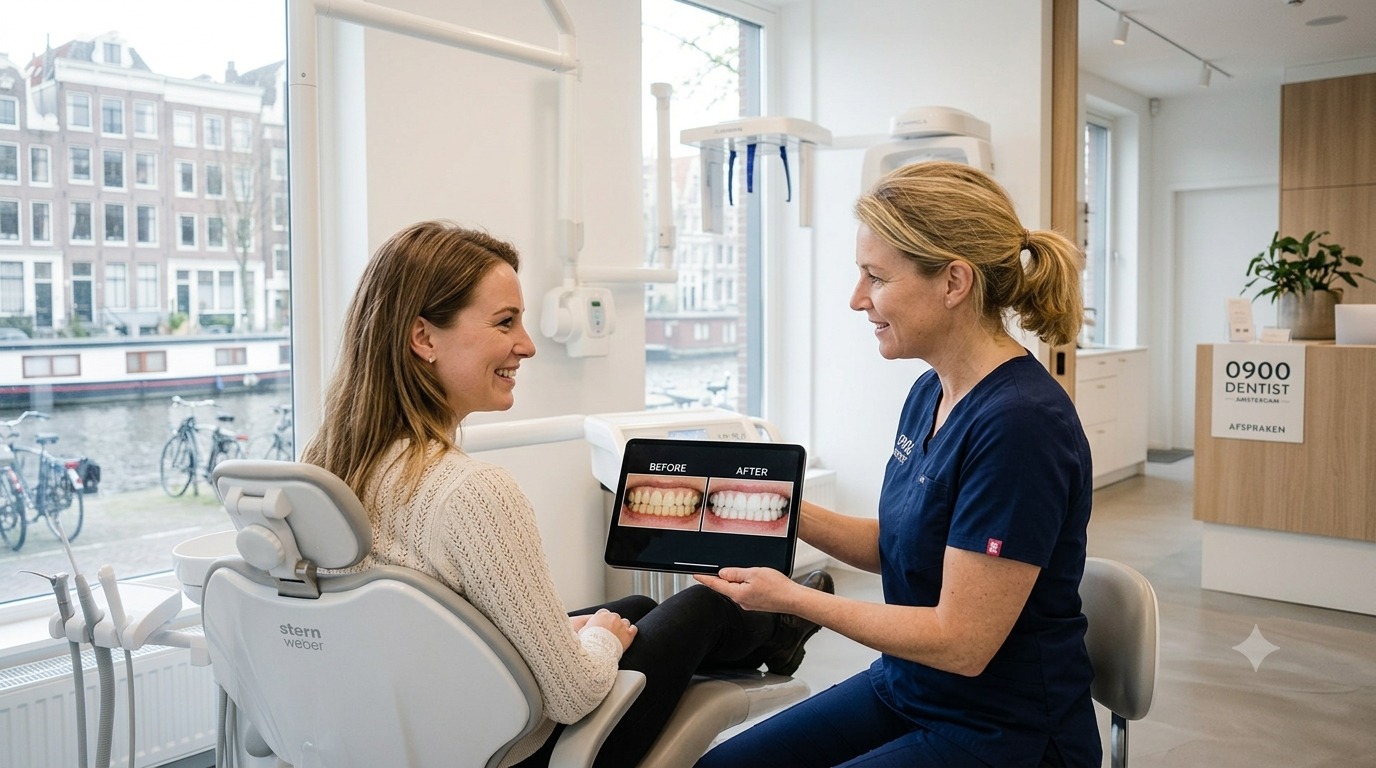
Two clinical formats are available: in-office whitening (one to two appointments, immediate results) and take-home trays (custom-fitted trays with prescription-strength gel, used nightly over two weeks). In-office is faster; take-home sometimes produces comparable or better long-term results because the slower oxidation process is gentler on enamel.
 blog6inbetween2
What Whitening Cannot Do
Change the colour of crowns, bridges, veneers, or composite fillings — these materials are peroxide-resistant and will stay their original shade while natural enamel whitens around them, creating a visible mismatch
Correct tetracycline staining (grey banding from antibiotic use in childhood) beyond modest improvement — this usually requires veneers for significant aesthetic change
Proceed while active gum disease or untreated decay is present — oral health must be stable first
If you have active gum disease, see our periodontitis treatment page before booking whitening. A routine checkup can confirm whether your mouth is ready for whitening.
How Long Do Results Last?
Professional whitening results typically last twelve to twenty-four months with normal dietary habits. Coffee, tea, red wine, and tobacco restrain enamel over time. Periodic top-up sessions or maintenance use of take-home trays keeps results stable. Sensitivity after whitening is common and temporary — it typically resolves within 48 hours. A clinical assessment beforehand identifies higher-sensitivity patients so the protocol can be adjusted.
What to Ask Before Booking Whitening Anywhere
What concentration of hydrogen peroxide does the treatment use?
Who is the supervising dentist?
Are there existing restorations on my visible teeth that would create a color mismatch?
Is there any underlying dental issue that should be treated first?
If those questions cannot be answered clearly, the information you need is not available. At 0900 Dentist, whitening consultations are part of the treatment planning process — we tell you what result is realistic for your case before you spend anything.